HW 3/3

Assignment One: Rough Draft

At this time, ‘blacks’ were treated poorly, and were trying to push for suffrage, and equality, and to diminish the racial tensions between themselves, and the whites. Several white supremacists were still trying to demean ‘blacks’ and say how they were lesser humans due to the color of their skin. However in an attempt to educate not only whites, but those who don’t truly understand what struggles ‘blacks’ were facing at the time, one author stands out in his writings. In the specific writing of ‘The Strivings of the Negro People’, the author, W. E. B. Du Bois, illustrates the struggles and everyday challenges that African-Americans must face due primarily thanks to the color of their skin. He explains how a vast majority of ‘blacks’ in America long for the time where they will be accepted not as ‘blacks’ but as Americans, and given the same suffrage, equality, and ability to explore their lives as a white man in America. To make his writing such a strong piece, Du Bois utilizes both a trustworthy and emotional approach (ethos), in his writing to make a sort of plea to his readers, to not only help humanize his essay, but to also provide this view on both himself, and his race. If you really look into this essay by Du Boiis, it is easy to tell that Du Boise gives off his honest opions based off of where he has come from, and who his family was. By doing this, Du Boise will come off as a more down-to-earth writer, and as an author looking for help, rather than an author demanding a change. In this essay, Du Bois brings forth several valid reasons, as well as solid reasoning behind his thoughts. In a specific instance, Du Bois says “The freedman has not yet found in freedom his promised land” (145). This one quote has a huge meaning for Du Bois, and the ‘blacks’ that he is also speaking for. Although some African-Americans are free, those who are ‘free’ are still locked away by the society that they are supposed to be free in. Speaking directly about the white supremacists, and their culture that is solely made to diminish and demean those of color.

CL 3/3

  • Warrant: unspoken values a writer thinks he shares with his readers. (These warrants are shaped and come from the discourse).
  • Specific Discourse Community: White Supremacists.
  • Argument Style: (evidence, reason, format, genre of writing), which is derived from his discourse community.
  • Knowledge: Made from discourses, and uses Multiliteracies for individual members to use.

Rhetorical Triangle: ‘Strivings of the Negro People’

  • Rhetorical Appeal: Trustworthy & Emotional Appeal (Making a Plea?/ Humanizing the Essay, as well as himself/race).
  • Readers: People who were not educated on the issue that he is presenting. (White readers, those who don’t share his views).
  • Writer: A respected figure, who has strong views on the subjects around; African Americans, Slavery, and the Treatment of Blacks, in America.
  • The Gap: People don’t understand the perspective that African Americans have, and what challenges they have to face on a day to day life due to the color of their skin.
  • (Disadvantages, and why these struggles are important to know).
  • Issue: The struggles that African Americans face in longing for the chance to be accepted in their country, as Americans, not as just Blacks. (Specifically African American rights, and suffrage).
  • Claim: Du Bois is wanting to make it possible for ‘Blacks’ to also be viewed as Americans, without them facing hate by their peers, and without them losing their ability to have self-development and access to life’s opportunities. . .(Free Men are fighting for their Denied Freedoms and Rights).

HW 2/27

After looking over the class discussion covenant, I found that I agree with everything listed. I do not think that any of it should be changed, but perhaps add in that a student should be able to communicate with the teacher when they are working alone, and require a second set of eyes/ opinion on things. Lastly the hyperlink for the class needs to be changed.

CL 2/27

  • Claim–what is the writer’s thesis statement?
  • Reasons– a reason the writer provides that his thesis statement is true or at least valid.
  • Evidence– the testimony of experts; summary/paraphrasing/direct quotation of reputable source that studies the issue at hand; the presentation of data from an empirical study; anecdotal (not systematic or rigorously recorded) observations that backs a reason you (as the analyst) have called out.
  • Warrant– the unstated belief/values that tie the reason and evidence combo to the claim
  • Counterargument–the presentation of the writer’s opponent’s argument
  • Rebuttal– the writer explaining the flaws in her/his opponent’s argument

My Answers:

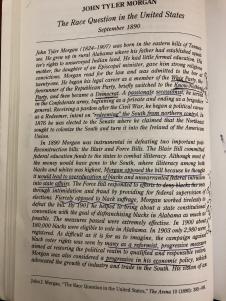
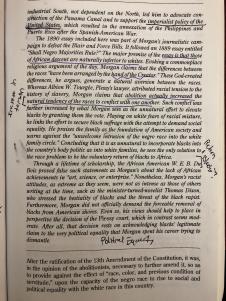
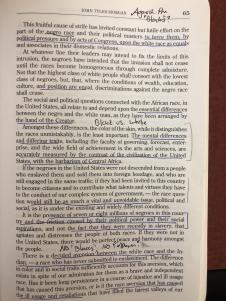
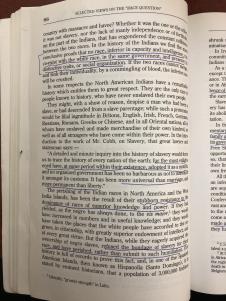
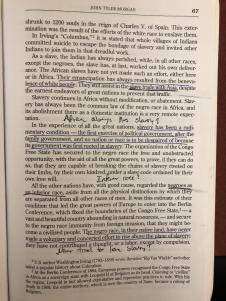
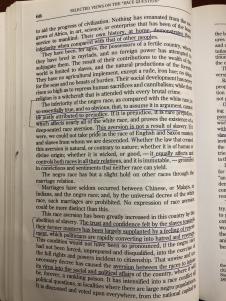
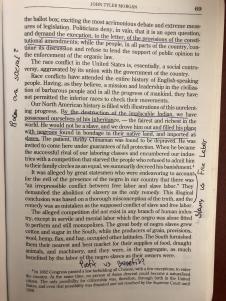
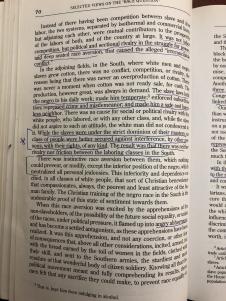
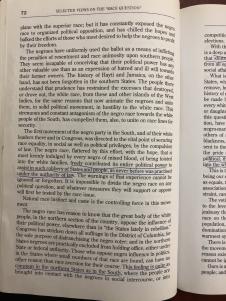
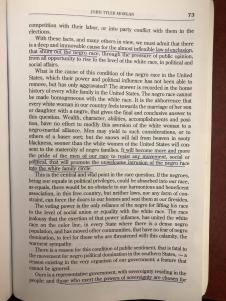
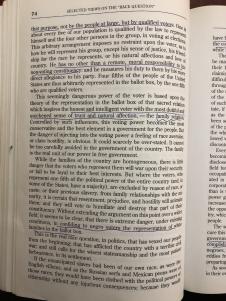
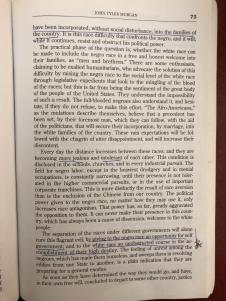
  • Claim: Morgan claims that it is not ‘natural’ for blacks to be included in the American political system, and that there are several issues that have risen due to them being in America. “Abolition actually increased the natural tendency of the races to conflict with each other”, Page 63. Morgan thinks that ‘blacks’ should go back to Africa.
  • Reason: If ‘blacks’ stay, then racial tensions will only get worse.
  • Evidence: Natural aversion due to the ‘law of similarity’. ‘Inflexible’ law of exclusion.
  • Warrant: He truly believes that sending ‘blacks’ back home is the best course of option for both races. He himself is a white supremacists, and is very racist, believes that their are laws that explain why their are tensions between the races, and that the best solution is to plainly separate the races back to where they ‘belong’. Since they will always be viewed as inferior to whites.
  • Counterargument: No actual counter-argument is provided.
  • Rebuttal: No rebuttal is provided.

Side Notes:

  • Rhetorical Appeal in the ‘Race Question”, is fear.
  • Claim: ‘It’s a waste to give Black Americans Rights.
  • Reason: White Americans will always see them as slaves.
  • Evidence: ‘Slavery has been common law, why would they change now?”
  • Counterargument: Black Americans do deserve rights (no actual one provided).
  • Rebuttal: No rebuttal is actually provided.

CL 2/20

Frederick Hoffman’s, “Race Amalgamation

  • The Gap: Mixing races is bad, not natural, against white supremacy. Why other races want to interbreed with each other. Maintaining Purity (why mix breeding is bad).
  • Audience: People who share his same views, people who don’t understand the ‘dangers’ of mixing races.
  • Writer: White Supremacist. Thinks that mixing races is bad, and against the natural way god intended races to be.

Toulmin Method:

  • Claim–what is the writer’s thesis statement?
  • Maintaining racial purity is something that people should do, and should stay away from mixing races, to not taint the white race in America.
  • Reasons– a reason the writer provides that his thesis statement is true or at least valid.
  • He adds in many ‘studies’ (poorly done scientific evaluations) that shows how mixing races taints the knowledge, and abilities of a ‘white’ man. When compared to a mixed person/ black person.
  • Evidence– the testimony of experts; summary/paraphrasing/direct quotation of reputable source that studies the issue at hand; the presentation of data from an empirical study; anecdotal (not systematic or rigorously recorded) observations that backs a reason you (as the analyst) have called out.
  • He references “scientists’ of the time and their ‘studied; to help prove his pint that mixing races would only be a bad thing. A specific example of this would be the study of the brain weight vs the degree of color that a person was, to show how mixing races made people have a smaller brain – therefore making them not as smart as whites (These studied however were “cherry picked”).
  • Warrant– the unstated belief/values that tie the reason and evidence combo to the claim
  • He believed that that people (his audience) were similar in the thought that mixing races is a bad thing to do, and take part in.
  • Counterargument–the presentation of the writer’s opponent’s argument
  • He doesn’t truly provide a counterargument.
  • Rebuttal– the writer explaining the flaws in her/his opponent’s argument
  • He doesn’t truly provide a rebuttal.

CL 2/18

The Mismeasure of Man

  • Prompt one: In your opinion, how do the activities of the individuals discussed in last night’s reading match Swales’s benchmarks for a discourse community?
    • I recommend you look over the six criteria Swales lists in his essay (pages 471-473).
    • You can focus on one, two, or all six of the benchmarks for your answer.
  • Prompt two: Based on your understanding of the reading you chose to write about in the question above, how did this discourse community spread the “knowledge” they were responsible for creating?
  • Prompt three: How do you think the thinking/writing/talking (the discourse) of the special interest group you chose to write about set the foundation for American Jim Crow laws?

Prompt One:

The activities, actions, and thoughts of the people inside of The Mismeasure of Man, had many things that aligned with Swales’s benchmarks for a discourse community. They include a specific lexis, especially when using words/terms such as ‘soft-liners’, and ‘hard-liners. They do have texts/ doctrines/ and theories presented towards their subject. They have a common thought/ belief that white men are the superior race, especially when compared to other races, such as ‘Indians’ and ‘Blacks’. Throughout the text, we are shown numerous examples such as doctrines, theories, and texts that several members in the group had read from, and wrote, to further their goal in establishing that whites were the superior race. Also when doing this, they were trying to establish a ranking system, and furthermore were trying to put ‘blacks’ below chimpanzees.

Prompt Two:

They spread the goal of their community, by analyzing and writing scientific journals, texts, theories, and doctrines. Furthermore, by utilizing these texts, they were ‘teaching’ other scientists, and those in the political hierarchy at the time that these certain things were true, and pushing the idea that there should be a ranking system, and that mixing races would halt the ‘white’ power. Specifically referring to Agassiz, he feared the marriage of a white person with a black person the most.

Prompt Three:

The group I’m looking at played a major role in introducing and leading the way towards Jim crow laws. They pushed for white supremacy, and the degradation of those who were not white, mainly ‘blacks’, ‘Indians’, and the ‘enfeebled’ mixed people. By pushing for ranking systems, and so much degradation, they not only paved the path for these laws to come, but helped to establish this racial way of thinking into the political hierarchy of the time.

HW 2/13

Annotation and Notes on : The Mismeasure of Man

  • Page 62: “Blacks and Indians as Separate Inferior Species”. Use of appeals to reason to promote hierarchies. Endless cycle? God?
  • Page 63: Humblest and Greatest? Biological Determinism, proposed by Plato. Racial Prejudice. A shared context of culture. Science introduced in the 18th and 19th century had it’s own views on race. Racial Rankings, ‘Hard-liners’, and ‘soft-liners’.
  • Page 64: American Heroes embraced racial attitudes? Biological inferiority?
  • Page 65:Compariosn of human skulls to chimp skulls to show lower rankings (blacks lower than chimps?).
  • Page 66: Douglas debates. Demagogism? Ruled by caprice, and ruled by customs.
  • Page 67: Comparison of Blacks to gorillas….
  • Page 68: More Comparisons…….
  • Page 69: Degradation of a specific race. Charles Darwin talks about a ‘gap’ from apes to humans. Racial differences due to climate differences.
  • Page 70: Humboldt, hero of modern egalitarians. -Against slavery and degradation. Cultural differences.
  • Page 71: Pre-evolutionary styles of scientific racism: monogenism and polygenism. Brings ‘justification’, ‘soft’ arguments. Adam and Eve?
  • Page 72: Humans perfect themselves? Change due to their own efforts. Comparison of races to animals. Theory of recapitulation (higher creatures repeat adult life of lower creatures).
  • Page 73:” Charles White, an English surgeon, wrote the strongest defense of polygeny in 1799. ‘Account of the Regular Gradation in Man’.
  • Page 74: “Louis Agassiz—America’s theorist of polygeny”. Walk on their own feet. Political independence. Poor country choice…..Slavery…Taking people from home.
  • Page 75: Centers of creation. Single center? Many centers?
  • Page 76: Camps (Lumpers). Doctrine of Human unity?
  • Page 77: ‘Christian Examiner’, published in 1850. Divines and abolitionists.
  • Page 78: Bible? Three races from one area? Not derived from single individual group? Moral imperative. Caucasian cultural stereotypes. Blacks at the bottom?
  • Page 79: “Education, he argues, must be tailored to innate ability; train blacks in hand work, whites in mind work”
  • Page 80: Regulations and limits put on blacks. No right to something if the man is ‘unfit’?
  • Page 81: Legal freedoms. Mixed and enfeeble people? Climates of their homeland? Choice?
  • Page 82: Darwin’s social preferences for racial segregation prevailed all. “Samuel George Morton—empiricist of polygeny”. Agassiz – Visits just for anatomical collections (Indian skulls).

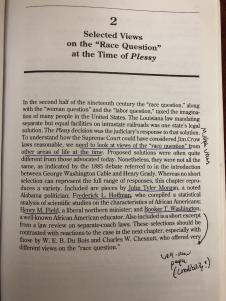
Annotation of Plessy v Ferguson coming soon! : Waiting on the book!

CL 2/13

Questions Concerning Plessy v Ferguson, or The Mis-measure of Man:

  • The people referred to during: The Mismeasure of Man who are they? Are they important? Are we going to re-visit them?
  • Specific Vocabulary words, meanings, and usage of words I’m not used to.

Questions Over; The Mismeasure of Man :

  1. How does Gould define biological determinism? (page 52)
  2. What are the two major sources of data that have supported this theme known as biological determinism? (page 52)
  3. What have biological determinists invoked when it comes to the issue of race? (page 52)
  4. According to Gould on page 53, biological determinism is useful for:
    1. Groups in power
    2. Groups not in power
  5. According to Gould on page 53, for the adherents of biological determinism, changes to a social and political system based on a racial caste system seen as an extension of nature is:
    1. Inconsequential
    2. an enormous costs for individuals psychologically
    3. an enormous costs for society economically
    4. Both 2) and 3)
  6. Gould’s arguments against biological determinism begin by attacking which two fallacies? (page 56)
    1. Reification and ranking
    2. Geocentrism
  7. In the last paragraph of page 56, what does Gould write is his book is about (his explanation continues onto page 57)?
  8. Finish this sentence, which can be found on page 59: “In most cases discussed in this book, we can be fairly certain that biases—though often expressed as egregiously as in cases of fraud—were unknowingly __________________________________________________.”
  9. On page 60, Gould describes biological determinism as a theory of limits. What does he mean by that?

My Answers:

  1. Behavioral norms, social and economic differences between human groups, about races, classes, and sexes, arise from inherited, inborn distinctions and that society, is an accurate reflection of biology. – Page 52.
  2. Craniometry ( measurement of the skull) and styles of psychological testing. – Page 52.
  3. Determinists have often invoked the traditional prestige of science as objective knowledge, free from social and political taint. – Page 52.
  4. Groups in Power – Page 53.
  5. Both 2 and 3.
  6. Reification (our tendency to convert abstract concepts into entities), and ranking (our propensity for ordering complex variation as a gradual ascending scale). Page 56.
  7. “This book, then, is about the abstraction of intelligence as a single entity, its location within the brain, its quantification as one number for each individual, and the use of these numbers to rank people in a single series of worthiness, invariably to find that oppressed and disadvantaged groups—races, classes, or sexes—are innately inferior and deserve their status.” Page 56-57. In short terms as he says himself, the book is about the mismeasure of man.
  8. ” influential and that scientists believed they were pursuing unsullied truth.” Page 59.
  9. It takes the current status of groups as a measure of where they should and must be. This includes the ‘rare exceptions’ as well.

Questions over Plessy v. Ferguson :

  1. According to Brook Thomas, the editor of Plessy v. Ferguson: A Brief History with Documents, what were the problems with laws designed to keep races separate (hint: it deals with the concept of skin color and “passing”)? (page 3)
  2. What did Albion Tourgee want the Supreme Court to do when it came to segregation laws? (page 4)
  3. Why was Homer Plessy chosen as a test case? (page 4)
  4. Why did Justice John Ferguson rule in favor of Daniel F. Desdunes riding a train over state lines but against Homer Plessy, who rode a train within the borders of Louisiana? (page 5)
  5. What is the difference between a social right, a political right, and a civil right? (page 12)
  6. Why does Congress pass a civil rights act? (page 13)
  7. According to Charles Walter Collins, what did the 14th Amendment do? (page 14)
  8. Which group was the first to bring a case before the Supreme Court citing a violation of their rights under the 13th and 14th Amendments (hint: it wasn’t African Americans)? (page 18.)

My Answers:

  1. They were designed to keep people separate, since there was already havoc about categorizing people as white or black.
  2. He wanted them to declare these laws as unconstitutional.
  3. Because he had ‘mixed blood’ and could pass as ‘white’.
  4. Because Daniel F. Desdunes was the son of one of the leaders of the New Orleans citizen committee.
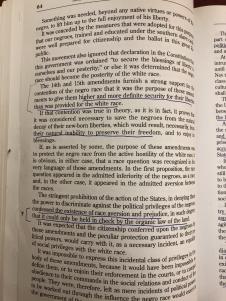
  5. Social Right: Is not secured by law. Political Right: Is secured by law. Civil Right: Nonpolitical rights upheld in citizens of a particular country. They are the middle ground between political and social rights.
  6. They believe that some social rights are so important that they should receive legal protection.
  7. Shifted The Court of final appeal from the State to the federal supreme court.

CL 2/6

Why Swales’s Article Is Bad:

  • The reading was dry ( too dry for reading in one sitting)
  • The words were too technical for people outside of the profession
  • Why do people care?
  • It’s not meant for ‘us’
  • The reading is long for a paper
  • The words don’t make sense (technical jargon/ technical terms)
  • BORING, BORING, BORING
  • Why does it matter for this class?
  • Beats around the bush for the main point
  • I had to read it for a class…
  • Wasn’t interesting
  • VIDEO NOTES:
  • Rhetoric, language used to persuade.
  • Rhetorical Situation: audience, speaker, issue.
  • Writing does not exist in a vacuum.
  • Be an audience friendly writer.
  • Who is my audience? What does my audience care about? What does my audience know? What counts as evidence?
  • How do you portray yourself? What is appropriate?
  • What is the conversation? Where are the gaps?
  • If we take this as true, in your own words describe what you think Swales sees as the gap in this conversation he’s participating in (the conversation described by the editors in the preface to the chapter).
  • I believe that swales thinks that the gap is the people don’t know how to properly establish a difference in written, and verbal rhetoric, as well as what defines certain groups of rhetoric.
  • In your opinion, how does this piece fill that gap?
  • In his article, Swales defines 6 defining characteristics of community discourse, and Discourses, and he establishes at least to himself what he believes to establish the difference between written and verbal rhetoric.
  • Who do you think is the audience for this essay?
  • I would believe that the audience for an essay like this, would be other English professors, or people who are substantial in the literature world. So that they can understand what Swales is trying to persuade that their is a defining difference between written and verbal rhetoric.
  • What’s the danger of an essay like this?
  • The danger of an essay like this, is that it is meant for a very specific group of people to read, and could confuse and bore many other readers who happen to find it in their hands. Another danger in an essay like this, is that the readers may not fully agree or disagree with some of Swales’s arguments/points.

Design a site like this with WordPress.com
Get started